
Abington Superior Roofing provides roof leak repair in Abington, PA by finding where water actually gets into the house, serving surrounding cities including Lower Moreland, Upper Southampton, East Goshen, Warwick Township and Plymouth Township. In more than 20 years of chasing leaks through local attics, we have learned that the stain on the ceiling is a symptom, and the cause is usually somewhere else.
Every leak call includes a look in the attic as well as on the roof. We follow the water trail back along the rafters and decking to its entry point before we price anything, so the repair addresses the real failure instead of the nearest shingles.
That discipline matters because a misdiagnosed leak costs twice: once for the wrong repair, and again for the right one after the next storm. When the problem turns out to be plumbing, condensation or a window rather than the roof, we tell you that too.
How We Trace a Roof Leak
Starting in the Attic
The attic shows what the shingles hide. We look for wet or stained decking, darkened rafters, rusted nail tips, damp insulation and drip marks, and we follow those signs uphill toward the source. A flashlight and patience find more leaks than any guess made from the driveway.
We photograph the trail as we go, so you can see how water moved from the entry point to the ceiling. Those photos also become part of the repair record for the house.
Following Water Along Rafters and Decking
Water that gets past the shingles lands on the underlayment or decking and runs downhill until it finds a low point, a nail or a seam to drop from. It can travel several feet along a rafter before it reaches the ceiling below.
That is why a stain in a bedroom can come from a chimney or a vent pipe well up the slope. Tracing the path rather than assuming the source is the difference between a repair that holds and a patch that does not.
Water Testing a Suspected Spot
When the attic narrows the search but does not settle it, we water test. One person runs a hose on a single area of the roof, working uphill section by section, while another watches the attic for the first drip.
It is slow, deliberate work, and it removes the guesswork. When the drip appears, we know exactly which flashing, boot or shingle course is failing.
Where Roofs in This Area Leak Most
Chimney Flashing
Masonry chimneys are the leading leak source we see on older houses. Step flashing, counter flashing set into the mortar, and the front apron all have to work together, and old repairs smeared with roofing cement eventually crack open.
We rebuild failed chimney flashing with new step and counter flashing cut into a reglet, and add a cricket behind wide chimneys so water and snow stop pooling there. A properly flashed chimney stops leaking for good rather than for a season.
Valleys, Dormers and Sidewalls
Valleys carry more water than any other part of a roof, and worn or poorly cut valley shingles leak under heavy rain. Dormers and second-story walls add another weak point where the roof meets the siding.
We replace worn valley material, install new step flashing course by course at dormer and sidewall joints, and add kick-out flashing at the bottom of each wall. That last piece keeps water from running behind the siding.
Pipe Boots, Vents and Skylights
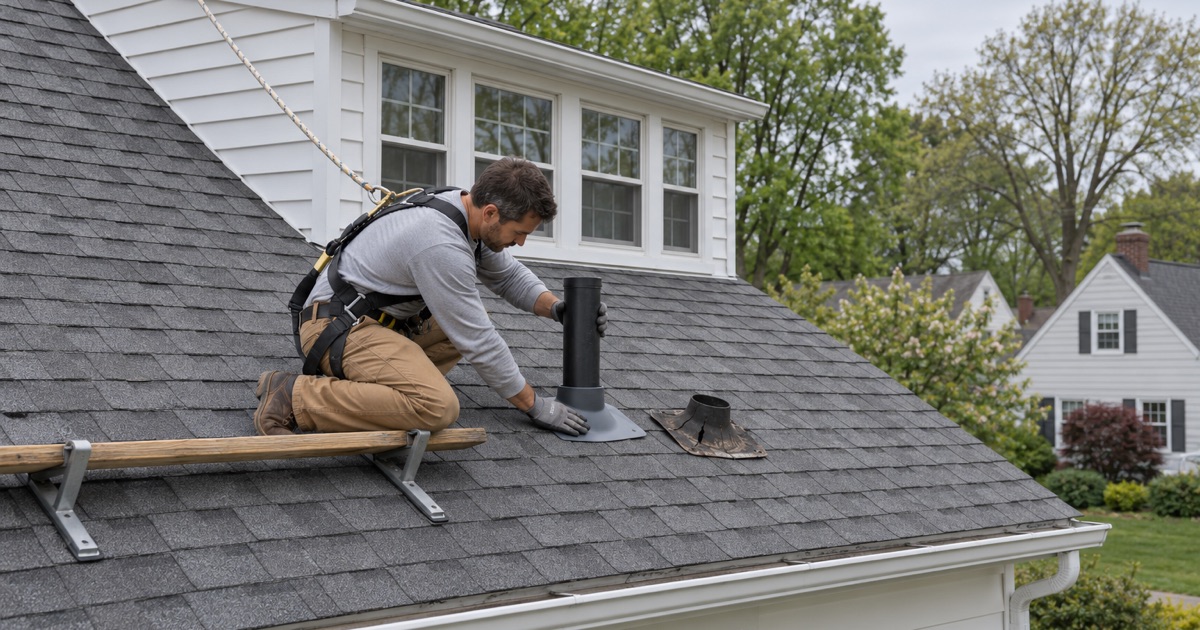
Rubber pipe boots crack in the sun, exhaust vent housings break, and skylight curbs lose their seals. Each opening in the roof is a place where the waterproofing depends on a single part.
We replace cracked boots with lead or long-life boots, replace damaged vent housings, and reflash skylights with the correct kit instead of caulk. These repairs are quick, and they stop a large share of the leaks we trace.
Eaves, Ice Dams and Gutter Edges
In winter, heat escaping into the attic melts snow that refreezes at the cold eave and backs water under the shingles. At the gutter line, missing drip edge or a badly hung gutter sends water behind the fascia.
We repair the damage and then deal with the cause, whether that is attic insulation, ventilation, a missing ice barrier or the gutter itself. Fixing only the symptom guarantees the same leak next winter.
Leaks That Are Not the Roof
Attic Condensation and Bath Fans
In cold weather, warm moist air rising from the house condenses on the cold underside of the roof deck. It can drip or melt off as frost thaws, and it looks exactly like a roof leak from below.
Bath fans that vent into the attic instead of outdoors are a common cause. We check fan ducts, attic ventilation and air leaks around fixtures, and fixing those often solves a leak that no shingle repair ever would.
Plumbing, HVAC and Windows
Supply lines, drain lines and air conditioning condensate lines in attics and ceilings can leak at any time, regardless of weather. Window and siding leaks can also run inside walls and appear on a ceiling below.
If what we find points to plumbing, HVAC or a window, we tell you so and show you why. You should not pay for roof work that will not stop the water.
Stopping the Water Now
Emergency Tarping
When water is actively coming in, the first job is to stop it. Where it is safe to get on the roof, we install a properly secured tarp over the leaking area to protect the interior until a permanent repair can be made.
The tarp is a temporary measure, and we schedule the real repair as soon as the roof is dry. Keep receipts for any emergency work, since they may matter for an insurance claim.
Protecting Ceilings and Insulation
Inside, move furniture and belongings away from the leak, put down containers, and if a ceiling is bulging with water, a small hole at the lowest point lets it drain in a controlled way. Keep away from wet light fixtures.
Once the roof is repaired, wet insulation in the attic should be pulled and replaced so it does not hold moisture against the drywall. We tell you what we see from above so you know what the interior repair involves.
Leaks on Flat and Low-Slope Roofs
Finding the Source Under a Membrane
On a rear addition, porch or commercial building with a flat roof, water can enter at one seam and travel across the deck under the membrane before it shows inside. The drip inside may be well away from the opening above.
We walk the membrane looking for open laps, split blisters, punctures and failed wall flashing, and we probe for soft areas that signal wet insulation. On larger roofs we work outward from the leak in a grid until the source is confirmed.
Drains, Scuppers and Wall Flashing
Many flat-roof leaks start where water collects: at a clogged drain, an undersized scupper, or the joint where the roof turns up a wall. Standing water finds every weak seam, and it keeps working on them long after the rain stops.
We clear and reflash drains and scuppers, rebuild flashing up walls and parapets with membrane matched to the roof, and point out low spots that hold water. When the membrane has reached the end of its life across the whole roof, we say so rather than patching seam after seam.
Keeping a Record of Every Leak Repair
Each repair we make is photographed before and after, with notes on what failed and what we installed. Those records stay with your file, and copies are yours to keep.
If the same area ever leaks again, that history tells us immediately what was done and narrows the search. It also helps when you sell the house, because a documented repair answers the leak question on the disclosure form with facts.
- 20+ Years in Roofing
- Free Written Estimates
- Line-by-Line Scopes